




Your disc is not broken.It is asking for better conditions.
What modern science knows about disc biology — and why the old story of degenerative, irreversible damage is far less true than you have been told.
You bend to pick something up and feel it. That dull compression. That catch between the shoulder blades, or the low back that tightens before you have even finished the movement. You have been told the disc is worn, that this is age, that the body is simply winding down.
But what if the disc is not worn out — what if it is running dry?
“The intervertebral disc is not an inert cushion. It is a living, pressure-sensing, fluid-exchanging organ — and it responds to the conditions you give it.”
This is not a consolation. This is the biology — and it changes everything about how we approach back pain, stiffness, and long-term spinal health at Optimal 365.
The disc as a hydrated spring
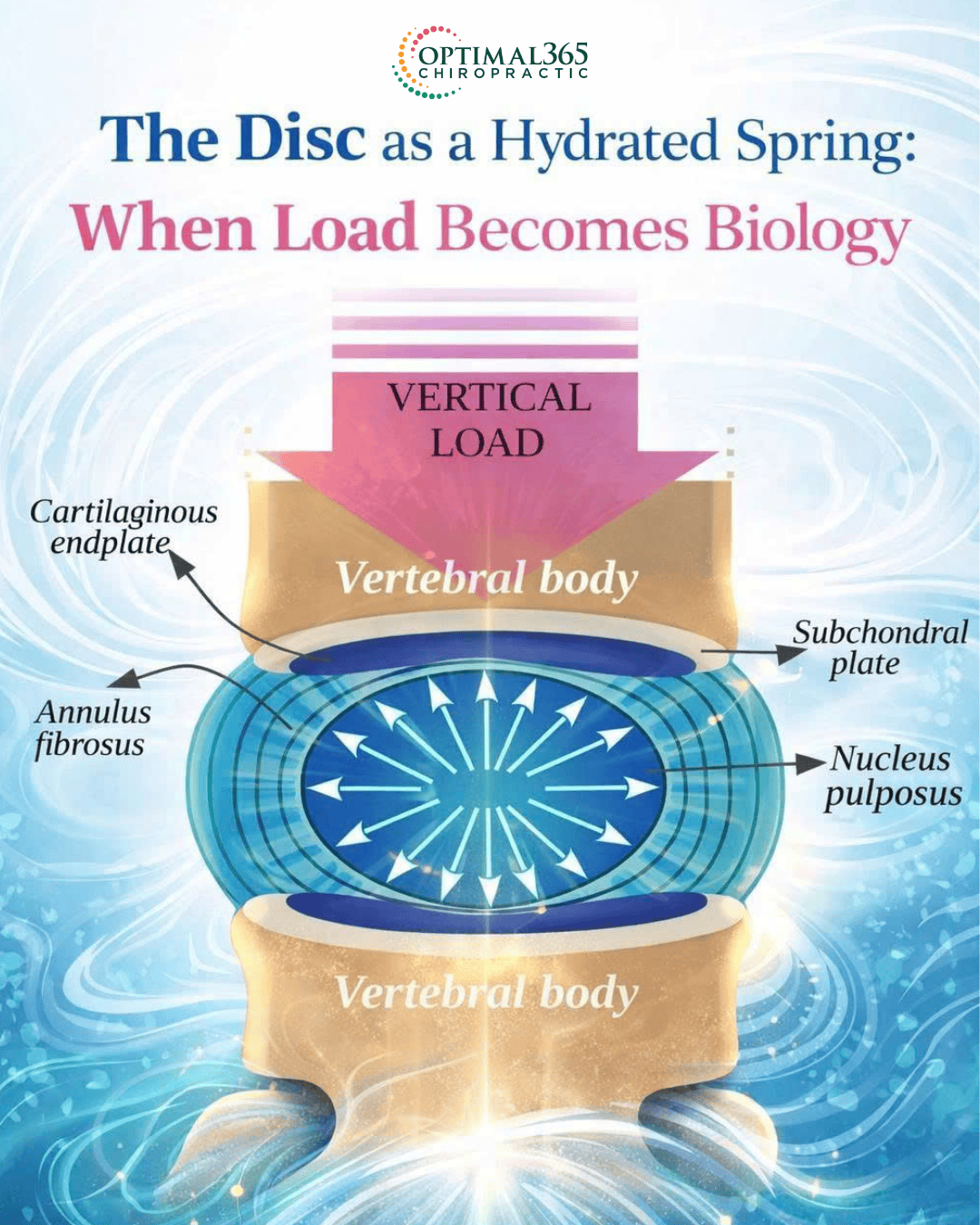
The intervertebral disc sits between each vertebral body, absorbing and distributing the vertical load that gravity places on your spine every waking hour. It has two primary structures working in concert. At its centre: the nucleus pulposus, a gel-rich core that holds water under pressure and distributes compressive force radially — outward in every direction, like the spokes of a wheel. Around that core: the annulus fibrosus, a series of concentric fibrous rings arranged in alternating diagonal layers, designed to contain that pressure and convert it into tensile strength.
Think of it as a sealed hydraulic spring. Vertical load compresses the nucleus. The nucleus pushes outward. The annular rings resist and redirect that force. The system holds. Load is managed. The spine stays supple.
This works beautifully — provided the nucleus remains hydrated. And here is where the conversation shifts from mechanics to biology.
Why discs dehydrate — and why movement is medicine
The intervertebral disc is avascular. It has no direct blood supply. It receives its nutrition — oxygen, glucose, the building blocks it needs to maintain its proteoglycan matrix — through diffusion. Fluid moves in and out across the cartilaginous endplates like a slow tide: load drives fluid out, unloading draws fluid back in. This exchange is the disc’s only method of feeding itself.
Which means the disc is a movement-dependent organ.
Sustained compression without variation — sitting for hours, poor posture held all day, repetitive loading in the same mechanical pattern — progressively impairs that fluid exchange. The nucleus loses hydration. The disc loses height and pressure tolerance. The annular rings bear asymmetric stress. Over time, micro-damage accumulates faster than repair can follow.
This is not inevitable wear. This is a mismatch between the disc’s biological requirements and the conditions it is living in. And that mismatch is largely reversible — not through rest, but through the right kind of loading, at the right frequency, with the right quality of movement.
| The biology of disc health — four key signals |
| Disc height and nucleus hydration decline when compressive load is static and unvaried. The tissue needs rhythmic, graduated movement to drive fluid exchange. |
| Annular integrity depends on load distribution: when spinal alignment shifts and force passes asymmetrically through the disc, annular fibres are placed under cumulative shear stress that outpaces their capacity to remodel. |
| Inflammatory cytokines accumulate in a dehydrated disc environment, shifting nucleus pulposus cells toward a degradative rather than anabolic state. The biology of the disc changes with its chemistry. |
| Cartilaginous endplate permeability — the gateway for nutrient diffusion — is sensitive to mechanical loading patterns, smoking, poor glycaemic regulation, and systemic inflammation. The disc’s health is inseparable from whole-body physiology. |
From mechanics to whole-system biology
This is where the systems biology lens opens the picture fully. The spine does not exist in isolation. The disc does not degrade in isolation. The load that passes through your lumbar vertebrae is shaped by the tension in your hip flexors, the activation timing of your deep stabilisers, the posture your nervous system has learned as its default, the inflammatory environment your metabolism is maintaining, and the quality of sleep in which your body is attempting to repair.
Chronic low-grade inflammation — driven by poor dietary patterns, visceral adiposity, disrupted sleep, or sustained psychological stress — shifts the systemic environment toward one that accelerates disc catabolism and impairs tissue repair. The HPA axis, when chronically activated, elevates cortisol; cortisol suppresses the anabolic signalling that healthy connective tissue requires. The disc feels this. Fascia feels this. The endplates feel this.
Conversely, when inflammation is managed, when metabolic signalling is optimised, when the nervous system moves from threat-response toward coherence — the biological conditions for disc health improve. The body is not simply a structure to be adjusted. It is a system to be regulated.
How Optimal365 works with disc health
At Optimal365, our approach to disc health is built on this integrated understanding. We do not treat a disc in isolation. We work with the whole-system environment that the disc lives within — restoring the conditions under which the body can do what it is designed to do: load, adapt, recover, and remain resilient.
| Chiropractic Care
Restoring segmental mobility and spinal alignment changes how load distributes through the disc — reducing asymmetric annular stress and supporting nutrient diffusion. |
Physiotherapy
Targeted loading, nerve mobilisation, and movement retraining address both structural contributors and the neuromuscular patterns that perpetuate disc stress. |
| Rehabilitation
Progressive loading of the deep stabiliser system rebuilds the proprioceptive and mechanical infrastructure that protects the disc under the demands of daily life. |
Nutrition & Lifestyle
Anti-inflammatory nutrition, blood glucose regulation, sleep optimisation, and stress physiology — shifting the systemic environment toward repair, not degradation. |
What recovery actually looks like
Recovery from disc-related pain is rarely linear. The body reorganises in layers — first reducing the acute inflammatory load, then retraining the movement patterns that the nervous system had restructured around pain, then gradually rebuilding the capacity to tolerate the loads that daily life requires.
Progress feels like this: mornings that start less stiff. A walk that does not require the same conscious guardedness. A return to activities abandoned months ago — not with bravado, but with a quiet sense that the spine has reclaimed something.
This is biology expressing coherence. It is not dramatic. But it is real, and it is available to most people presenting with disc-related pain — provided the intervention addresses the whole system, not only the symptom.
Three things to do differently, starting today
Even before your first appointment, there are evidence-informed shifts that begin to change the biological environment of your disc:
| Three entry points for disc health |
| Break up static loading. Set a rhythm of postural variation — standing, walking briefly, changing your seated position — every thirty to forty minutes. The disc needs this variation to sustain its fluid exchange. Inactivity is not protection. |
| Reduce systemic inflammation at the table. A diet high in refined carbohydrates and seed oils maintains an inflammatory signal that the disc tissue registers. Moving toward whole foods, omega-3 fatty acids, and adequate protein begins to shift the chemistry the disc is living in. |
| Protect sleep as structural medicine. Growth hormone is released during deep sleep — it is the primary anabolic signal for connective tissue repair. Poor sleep does not simply leave you tired; it interrupts the repair cycle your disc depends on every night. |
The disc that has been labelled worn, degenerated, or beyond repair is rarely beyond influence. Its biology is responsive to the conditions you create — through how you move, how you load, how you eat, how you sleep, and how well the system of practitioners around you understands the whole rather than only the part.